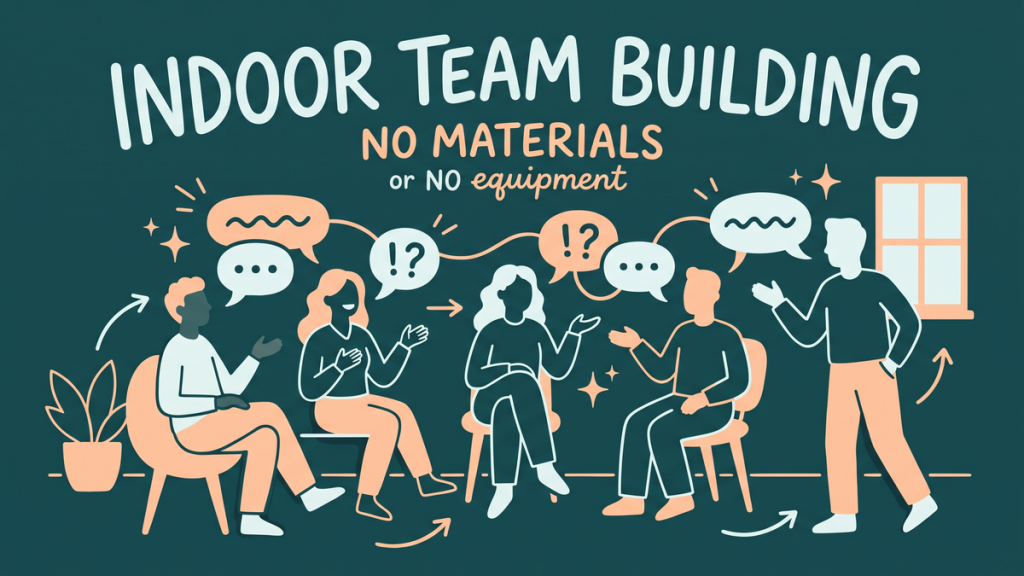
The meeting room is available, but the activity box is missing. There are no sticky notes, markers, printed cards, or spare laptops. You can still run an indoor team activity, provided the game genuinely works through conversation rather than quietly depending on equipment.
These indoor team building games without materials need only people and a shared space. A facilitator helps, but a phone timer, projector, or whiteboard is not required. Suggested times are flexible; you can end a round by counting turns instead of watching a clock.
Choose the activity for the kind of interaction you want: careful listening, explaining an idea, noticing assumptions, or building something together in words. Nobody should have to disclose personal experiences, stand up, close their eyes, or accept physical contact to take part.
Start with an invitation, not a surprise test
Tell the group what will happen and roughly how long it will take. For example: “We will try a short listening game, then discuss one thing that made it easier. You can pass or observe.”
That is more welcoming than announcing an unexplained challenge and asking people to perform immediately. Avoid using the activity to assess individual staff members. A playful response is not evidence about somebody’s competence, commitment, or personality.
All the games below have a seated version. In a remote meeting, they can also work through ordinary audio, although the meeting technology is an additional requirement in that setting. In the room itself, no materials are necessary.
Game 1: The Accurate Echo
Best for: Three to eight people practicing careful listening. Suggested length: One round per person.
The first person gives a short, invented plan containing three details: “We will open the reading room on Tuesday, invite six guests, and start with a puzzle.” The next person repeats the plan in their own words, preserving those details, then adds one new detail.
Continue for a few turns, then reset with a fresh plan. Do not build an endlessly long memory chain. The challenge is to listen for meaning, not embarrass the person who forgets a word.
If somebody misses a detail, the original speaker clarifies it kindly. Ask, “Which details were essential, and which wording could change?” This distinction is useful when summarizing meeting decisions: the exact sentence may not matter, but the date and responsibility do.
Game 2: Explain It to a Visitor
Best for: Three to six people practicing plain language. Suggested length: Two short attempts each.
Choose an ordinary object or process, such as a library card, a reusable bottle, or borrowing a board game. One participant explains it to an imaginary visitor who has never encountered it. Others can ask simple questions but should not deliberately misunderstand every sentence.
After the first explanation, the speaker tries again using one everyday comparison. For example, “The return date works like a reminder of when the next person may need it.”
Debrief with, “Which explanation became clearer when we removed an assumption?” Avoid specialist subjects that give one participant an overwhelming advantage. The game works best when everyone understands the subject but has to think about how to explain it.
Game 3: The One-Sentence Project
Best for: Four to eight people practicing concise collaboration. Suggested length: Three passes around the group.
The group invents a small community project in three rounds. In round one, each person adds one sentence about what the project does. In round two, each adds a sentence about how someone would use it. In round three, each identifies one obstacle and a possible response.
A project might become a neighborhood book exchange, a shared repair afternoon, or a quiet lunch club. Participants should build on previous contributions instead of replacing the whole idea whenever their turn arrives.
Ask, “Where did our plan become clearer, and where did it become crowded?” The group can then summarize the final project in one sentence. This provides a natural ending without needing notes or a formal presentation.
Game 4: Same Goal, Different Route
Best for: Three to six people exploring alternatives. Suggested length: Two scenarios.
Give the group a harmless challenge: welcome a new member who arrives late, explain a room change, or organize a short break between activities. Ask the first person for a possible approach. Each following person suggests a different approach that still respects the same goal.
Once several options exist, compare their strengths. A room-change message could be announced aloud, explained at the original room, or included in the meeting invitation. Different situations may need different combinations.
Do not reward novelty for its own sake. An unusual idea that makes the task harder is not automatically better. Ask, “Which approach would work for somebody who missed the first message?” That keeps the discussion focused on the people using the process.
Game 5: The Helpful Question
Best for: Three to eight people practicing clarification. Suggested length: Three brief rounds.
The facilitator gives a vague request: “Make the event more welcoming.” Participants take turns asking one question that would help them act. They might ask who is attending, what currently feels difficult, or which part of the event can change.
After everyone contributes, the facilitator supplies a specific context. Perhaps new visitors cannot tell where to sit, or the welcome message uses unfamiliar abbreviations. Ask which earlier question would have uncovered that information soonest.
The objective is not to guess a secret phrase. It is to practice turning a broad request into a clear task. For a second round, use a different request such as “Make this easier to follow” and compare the information needed.
Game 6: Build a Better Instruction
Best for: Three to six people improving sequence and precision. Suggested length: Two complete instructions.
Choose a simple imaginary task, such as registering for a club session. The first participant states the first action. The next adds the second action, and so on. Anyone can pause the sequence to ask whether a step is missing or depends on information not yet available.
For example, “Choose a session” cannot happen unless the person can find the available sessions. “Confirm your place” may need an explanation of what confirmation looks like.
End by saying the complete instruction aloud. Ask, “Could a newcomer follow this without asking us anything?” Keep the process short enough to remember. If it grows complicated, reduce the task rather than making memory the main challenge.
Game 7: Change One Condition
Best for: Four to eight people practicing flexible planning. Suggested length: Three changes.
Agree on a simple plan for an imaginary workshop. Then change one condition at a time: fewer people attend, the room is smaller, or the opening activity must work without speaking.
The group changes only the parts affected by the new condition. This prevents every adjustment from becoming an excuse to rebuild the whole plan. After each round, name something that stays the same and something that needs to change.
Ask, “Which part of our plan was essential, and which part was just a preference?” This is a useful distinction when a real project meets a changed deadline or resource limit. Keep the scenarios ordinary rather than introducing emergencies or distressing situations.
Game 8: The Useful Summary
Best for: Any small group ending a session. Suggested length: One sentence each.
Ask every willing participant to finish a practical sentence: “One instruction I will make clearer is…” or “One question I will ask earlier is…” They can refer to a fictional example from the game rather than a real workplace problem.
The next speaker begins by briefly acknowledging an idea they heard, then adds their own. Passing remains acceptable. The facilitator finishes by naming one shared observation without claiming everybody agreed on everything.
This closing activity does not require an emotional disclosure or a public promise. It gives the session a useful final shape: we tried something, noticed something, and identified a possible improvement.
Adjust the game rather than blaming the group
If people hesitate, shorten the prompt and demonstrate a turn. If a few voices dominate, use a round where everyone has an opportunity before anyone takes another turn. If the activity feels repetitive, change the scenario or finish early.
No-materials team building games are useful precisely because they are easy to adapt. Keep the rules light, the purpose visible, and the conversation connected to something people can actually use. A short activity with a clear takeaway is better than a long game that everyone completes only out of politeness.