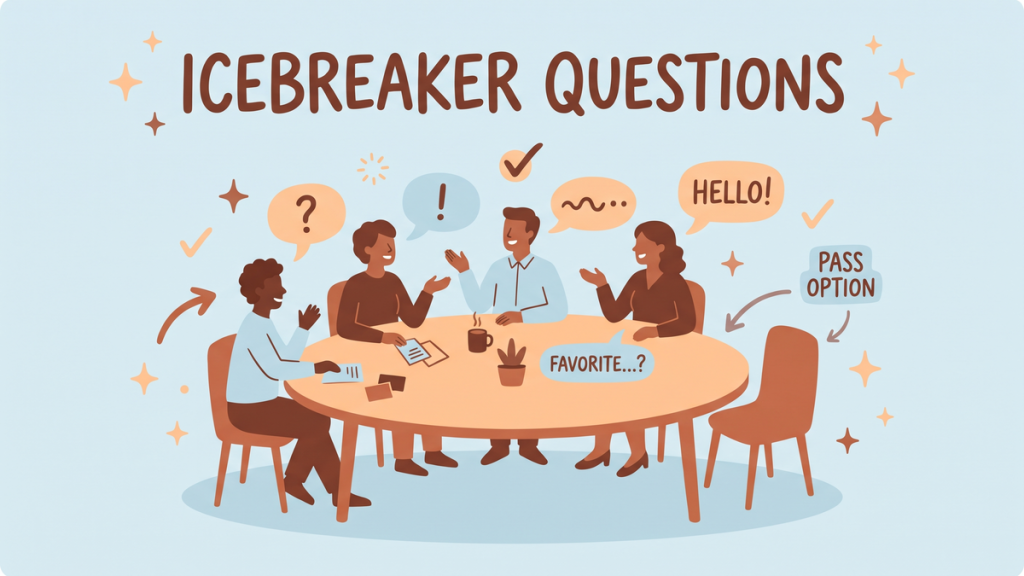
An icebreaker should make it easier to enter a meeting, not give everyone a second task to worry about. A useful question is easy to understand, relevant to the setting, and answerable without revealing something private.
These icebreaker questions for work are grouped by meeting purpose. Choose a quick opener for an ordinary check-in, a practical question for a new team, or a reflective prompt before a planning session. You do not need a dramatic confession, a childhood story, or a forced joke to get people talking.
A simple opening might be: “What is one small thing that makes a meeting easier to follow?” It invites useful answers from people with different jobs and experiences, without assuming they all enjoy the same social activities.
Choose the purpose before the prompt
Ask yourself what the opening needs to accomplish. Are people meeting for the first time? Returning after a break? Preparing to solve a problem? A question that suits one situation may feel out of place in another.
For a routine team meeting, keep the opener short and connected to the working day. For a social gathering, a more playful choice may fit. For a difficult or urgent meeting, it may be better to skip the icebreaker and acknowledge the situation directly.
Explain that passing is allowed. Offer a brief response of your own to demonstrate the level of detail expected. A facilitator who gives a two-minute personal story has made it harder to ask everyone else for a ten-second answer.
Quick check-ins that do not require a life update
Use these when you want a small opening rather than a long conversation. Invite one sentence, then move into the meeting.
- What is one small thing that helps you start a task?
- Which part of today’s agenda would you most like to understand clearly?
- What is a useful shortcut you learned recently, digital or otherwise?
- What makes a set of instructions easy for you to follow?
- Which everyday object on a desk is more useful than people give it credit for?
- What is one question worth asking before beginning a project?
- Would you prefer a short example or a short checklist when learning a new process?
- What is a small sign that a meeting has been well organized?
- Which routine task would you most like to make simpler?
- What is one kind of information that is helpful to receive early?
These are invitations, not a way to extract complaints on the spot. If an answer reveals a larger issue, acknowledge it and arrange an appropriate follow-up rather than turning the opening into an unplanned investigation.
Questions for a new team
New colleagues may not know which stories are safe to share or how informal the group usually is. Keep the questions specific, optional, and connected to collaboration.
- What kind of project explanation helps you get oriented quickly?
- What is a task you enjoy helping someone understand?
- When you join a project, what do you usually want to know first?
- What makes a handoff from another person especially useful?
- Which is easier for you to respond to: a rough example or a list of requirements?
- What is one helpful thing a teammate can include in a request?
- What is a skill outside your main role that you enjoy using?
- What is a simple way to make a shared document easier to navigate?
- When an idea is unclear, what kind of question helps you clarify it?
- What is one small courtesy that makes collaboration smoother?
Do not use the answers to assign fixed identities such as “the creative one” or “the quiet one.” A preference in one situation is not a complete description of how a person works. Treat the answers as starting points for understanding, not labels.
Light questions for a relaxed team gathering
These work icebreaker questions are playful without depending on expensive travel, family arrangements, drinking, or personal achievements. People can invent an answer instead of sharing a real experience.
- What ordinary object would make the funniest fictional team mascot?
- If a printer could speak, what helpful sentence should it say first?
- Which would be more useful: a mug that finds your desk or a notebook that finds your missing idea?
- What would you name a tiny robot whose only job is organizing cables?
- Which everyday process deserves a much clearer instruction label?
- If our fictional office had a theme tune, should it sound calm, cheerful, or adventurous?
- What harmless skill would make a surprisingly entertaining five-minute workshop?
- Which would you rather design: a better meeting invitation or a better snack cupboard?
- What is an amusing but useful title for someone who always finds the missing file?
- If a shared calendar could give one piece of advice, what should it be?
Keep humor aimed at imaginary situations, not at a colleague’s appearance, accent, age, role, or mistakes. A question is not harmless merely because the person asking it intended to be funny.
Reflective questions before planning
These prompts can help people enter a practical discussion. Choose one that connects naturally to the work that follows rather than forcing an unrelated motivational exercise.
- What would make the next step of this project easier to understand?
- Which assumption would be useful to check before we begin?
- What does a helpful first draft need, and what can wait?
- What is one sign that we should ask for clarification rather than guess?
- Which part of a recent process could be explained more simply?
- What is one decision we should record so it does not need to be rediscovered later?
- What would a newcomer find confusing about our current plan?
- Which small improvement would remove a repeated inconvenience?
- What information would help us compare the available options fairly?
- What would make today’s meeting feel complete rather than merely finished?
Avoid presenting these as anonymous feedback if answers are being given openly. If the discussion involves sensitive working conditions or conflict, use an appropriate feedback process rather than relying on a light meeting opener.
Three formats that change the experience
One-sentence round: Read one question and invite a brief response from each willing participant. This works well for a small group when everyone needs a predictable chance to speak.
Pairs, then share: Give pairs a question, let them discuss, and ask each pair to share one idea they both agree to share. This avoids making someone report another person’s private comment without permission.
Think first, volunteers second: Give quiet thinking time, then invite a few volunteers. This is useful when the group is large or the meeting has limited time. Do not interpret silence as a lack of interest or preparation.
For remote meetings, people may answer through voice or chat when that suits the meeting’s accessibility and participation needs. State the options clearly instead of assuming everyone will notice them.
A sample opening you can use
“Before we start, here is one optional question: what makes a project handoff easy to use? A short answer is enough, and passing is fine. Mine is a clear next action with a named file. We will hear a few ideas, then use them when discussing our handoff process.”
That introduction explains the question, the expected length, the pass option, and the connection to the agenda. It does not promise that the activity will transform the team or demand that everyone be enthusiastic.
For random prompts, add a screened selection to the Spin Wheel. Randomize the question rather than choosing a person who must reveal an answer. Keep sensitive topics out of the wheel before the session begins.
Notice what makes participation easier
If the first question gets blank looks, make it more concrete. “What inspires you?” is broad. “What helps you understand a new task?” gives people a manageable situation to consider.
If answers become long, thank the speaker and restate the one-sentence format for the whole group rather than singling someone out. If the meeting is already under pressure, finish the opener early.
The best icebreaker questions for colleagues do not ask people to perform a personality. They offer a small, comfortable way to contribute, listen, and begin the conversation that the meeting actually needs.