Imagine meeting a potential colleague who asks, “What kind of work do you do?” You probably would not recite every job you have held. You would explain your current focus, give an example, and add enough background to make the story understandable.
Your LinkedIn About section can do the same thing. The LinkedIn About section character limit is 2,600 characters. That is space for a useful professional introduction, not an obligation to write a miniature autobiography.
The strongest starting point is a simple question: what should a relevant reader understand about you after this section that they would not learn from your job titles alone?
Give the About section its own role
Your headline identifies your focus. Your Experience section records positions and work history. Your About section connects those facts into a readable explanation.
LinkedIn’s official profile-summary guidance identifies the About section as an open-ended professional summary with a 2,600-character maximum.
Use it to explain a specialty, a career change, the problems you enjoy solving, or the way your experience fits together. Repeating every bullet from your resume wastes the opportunity to add that context.
A four-part structure that leaves room for personality
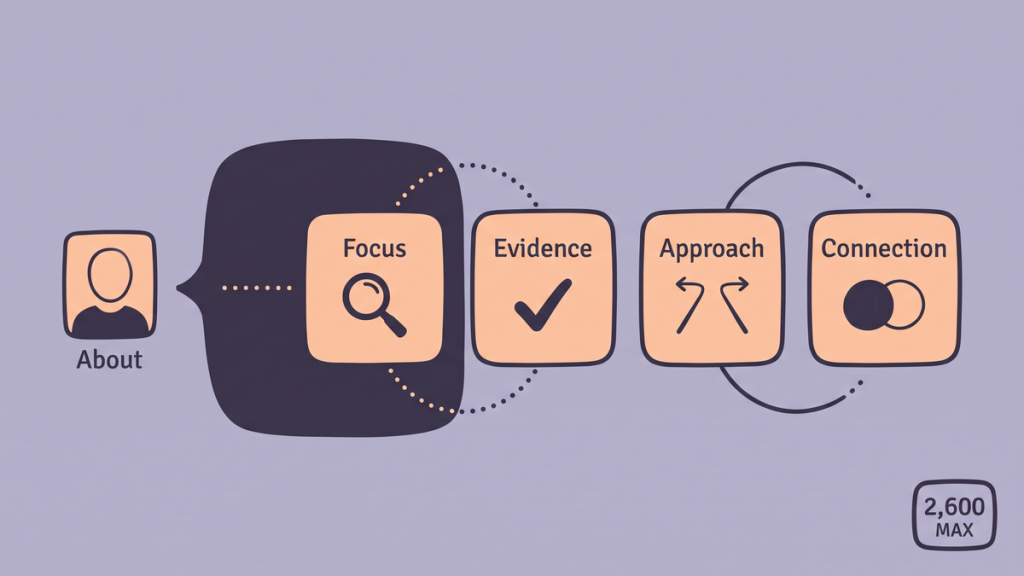
Think in four parts rather than a rigid template: focus, evidence, approach, and next connection.
The focus tells the reader what you do. The evidence gives one or two concrete examples. The approach explains how you work or what you pay attention to. The final connection tells a relevant reader why they might contact you.
Write in the first person if that feels natural. The goal is to sound like a thoughtful professional, not a promotional brochure describing a stranger.
An original example, then a closer look
Here is a fictional About section for an operations coordinator. Use it to study the structure, not as text to copy into a profile without matching experience.
“I help small teams make everyday work easier to track. My focus is operations coordination: clear schedules, reliable handoffs, and records that people can actually use.
In a recent internal project, I helped combine several task trackers into one shared checklist. I worked with colleagues to define an owner and a next action for each request. The most useful change was not adding more fields. It was removing fields that no one needed to make a decision.
I enjoy work that sits between people and processes. I ask questions, test a small version, and write instructions that a new colleague can follow without a long explanation. My experience includes coordinating recurring activities, maintaining shared records, and supporting teams when priorities change.
I am interested in operations roles where clear communication matters as much as careful administration. I welcome conversations with teams improving their internal handoffs or building a more consistent way to manage recurring work.”
The opening names the work. The project supplies a concrete example without an invented percentage improvement. The third paragraph describes an approach through actions. The ending names a relevant kind of conversation.
Replace broad claims with evidence you can explain
“Excellent communicator” is a claim. “I write setup instructions that new colleagues can follow without a meeting” gives the reader a clearer picture of the skill.
“Results-driven” is broad. “I review recurring support questions and turn the answers into help-center articles” explains the work.
You do not need a number in every sentence. A documented improvement can be useful, but a fabricated metric is worse than a precise description without one. Include numbers only when you can explain what they measure and where they came from.
Also respect confidentiality. A client name, internal process, or project result may require permission before it belongs on a public profile. An anonymized example can still show your contribution clearly.
Make a career change understandable
A career change does not need an apology. It needs a connection.
Suppose a teacher is moving into learning design. A useful opening might be: “After developing classroom materials and explaining difficult topics to mixed-ability groups, I am building a career in learning design.”
The next paragraph could describe a real training project, relevant study, or portfolio exercise. Label a personal or practice project accurately rather than presenting it as paid client work.
Explain what carries across: organizing information, checking understanding, designing practice, or responding to feedback. Then identify what you are currently learning. That combination is more credible than claiming instant expertise in an entirely new profession.
Students can use projects, not invented experience
A student may not have a long employment history, but they can still describe meaningful work. A research assignment, student society responsibility, volunteer activity, or independently built project can provide evidence.
For example: “In a group research project, I organized survey responses, checked missing entries, and helped turn the findings into a short presentation.”
That sentence explains the contribution. “Future visionary leader with unlimited potential” does not.
Keep the distinction between interest and experience clear. You can say you are interested in data analysis while describing the specific tools and tasks you have actually used. A reader should not have to guess which claims are established skills and which are future goals.
A practical character budget
You can use a loose planning budget without turning the section into a formula:
|
Part |
Possible share of your draft |
Purpose |
|---|---|---|
|
Professional focus |
A short opening paragraph |
Orient the reader immediately. |
|
Evidence |
One or two compact paragraphs |
Show what you have done. |
|
Working approach |
A few specific sentences |
Explain how you contribute. |
|
Relevant connection |
A short ending |
Make the next conversation clear. |
This is an editorial framework, not a LinkedIn rule. Start with the content, then check whether the completed version fits the 2,600-character allowance.
Remove repetition without removing your voice
Read the first sentence of every paragraph. If each says a version of “I am passionate about helping businesses,” choose the strongest one and use the other paragraphs for evidence.
Replace long introductions such as “Throughout the course of my professional career” with a direct statement about the work. Remove a skill list that merely repeats the headline or Skills section.
Keep one detail that makes the profile recognizable, such as the kind of problem you enjoy solving or the reason a particular career direction interests you. Specificity is more memorable than forced enthusiasm.
Check the saved profile, not just the draft
LinkedIn’s About-section editing instructions explain how to open the section’s edit control and save changes. Interface details can vary, so inspect the current profile after saving.
Use the online word counter to check a pasted draft, then confirm the final count in LinkedIn. Add links or symbols before that final check, not afterward.
Read the section on a narrow screen and make sure the opening is useful before any expansion. Check names, dates, credentials, and claims against the rest of the profile.
A good About section gives a relevant person enough context to begin a better conversation. It should sound like you explaining your work clearly, not like every possible professional keyword has been squeezed into 2,600 characters.