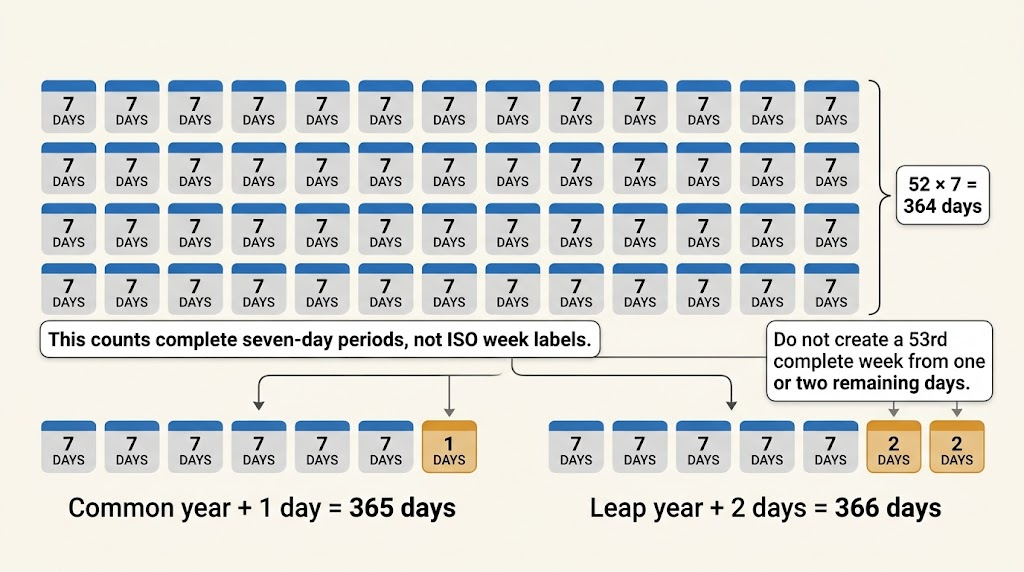
A year has 52 full weeks, but that is not the whole calculation. A common year contains 365 days, which is 52 weeks plus one day. A leap year contains 366 days, which is 52 weeks plus two days.
Then you open a calendar and find a box labeled “Week 53.” Has the calendar added a week? No. It is using a week-numbering system whose year boundaries do not always match January 1 and December 31.
Understanding those two ideas solves most questions about how many weeks are in a year: a quantity of days is not the same thing as a numbered calendar week.
Three answers that describe three different questions
If someone asks for the number of complete seven-day periods in a common year, the answer is 52. If they divide the full 365 days by seven, the answer is about 52.14 weeks. If they ask how many numbered weeks an ISO week-year has, the answer can be 52 or 53.
All three can be correct. Trouble starts when they are used interchangeably, such as treating a 53-week label as proof that a calendar year contains 371 days.
|
Question |
Common year |
Leap year |
|---|---|---|
|
How many days? |
365 |
366 |
|
How many full seven-day periods? |
52 |
52 |
|
What remains after those periods? |
1 day |
2 days |
|
Days divided by seven |
About 52.14 |
About 52.29 |
The numbered-week question belongs in a separate calculation. A particular week-numbering system needs rules about when a week starts and which week becomes week one. Those rules determine where the labels sit.
Put 364 days on the table first
The simplest way to see the arithmetic is to multiply 52 by seven. The result is 364. One additional day takes you to a common year’s 365 days; two additional days take you to a leap year’s 366 days.
Imagine arranging days into 52 boxes with seven spaces in each. A common year leaves one day outside the boxes. That extra day still exists, even though casual conversation often rounds the year to “52 weeks.”
This is also why the weekday of a fixed date normally advances by one from one year to the next, with a further shift when the relevant interval crosses a leap day. The weekly cycle continues rather than restarting whenever January arrives.
For planning an interval, count actual dates rather than multiplying every year by 52 weeks. The NavigationHubs Date Difference tool can help check calendar-day intervals. It is not an ISO week-number calculator, and you should make your endpoint convention clear.
Meet the ISO week-year
In the ISO system, weeks run from Monday through Sunday. Week one is the week containing the year’s first Thursday, which is also the week containing January 4. The Python documentation’s explanation of ISO calendar dates sets out these rules clearly.
That means week one can begin in December of the preceding calendar year. Similarly, the final numbered week can continue into January of the following year. The week is kept together rather than split into two labels at midnight on New Year’s Eve.
Think of it as a seven-day folder. The folder belongs to the year containing its Thursday. Some dates near New Year therefore have a calendar-year label and a different week-year label.
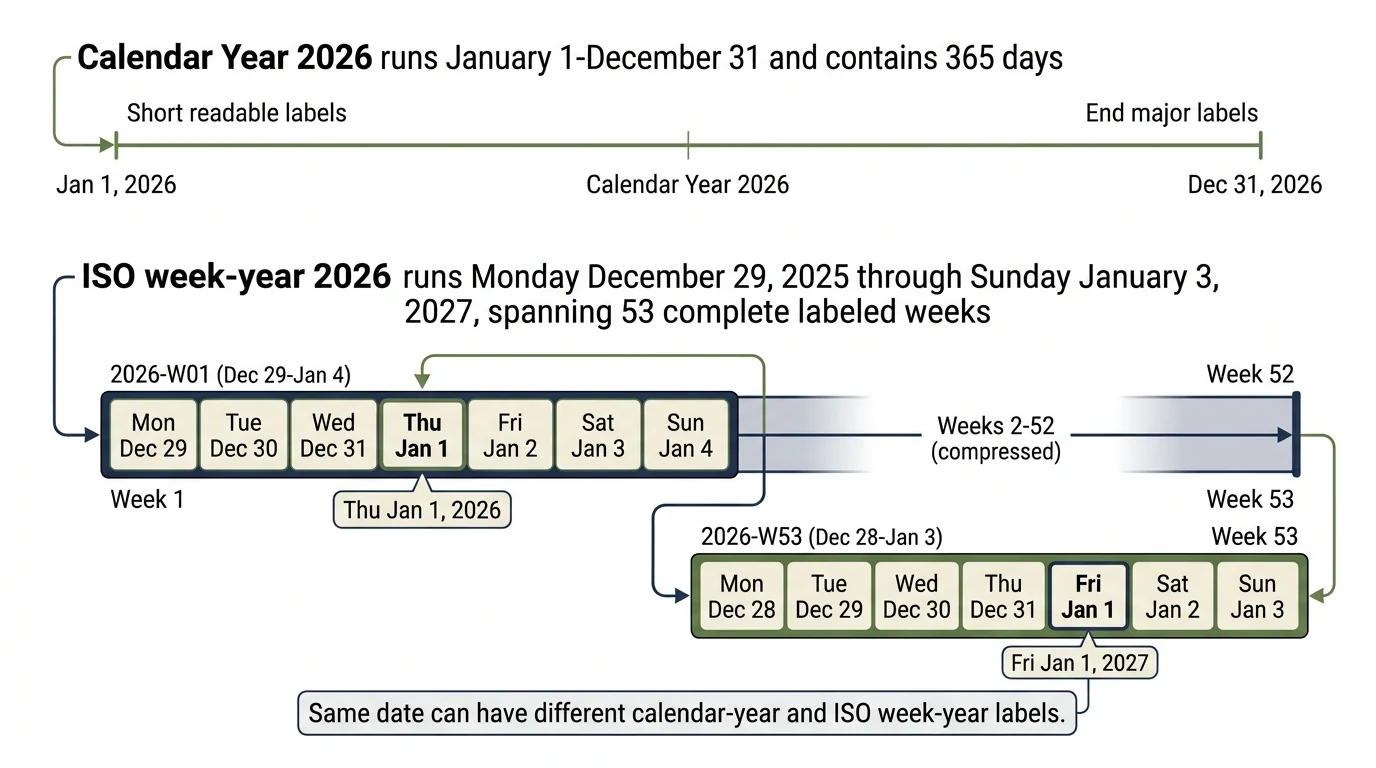
For example, January 1, 2027 falls in ISO week 53 of 2026. That does not turn the date into a day in calendar year 2026. It simply identifies the complete Monday-to-Sunday week to which the date belongs.
Why 2026 has a week numbered 53
The 2026 calendar year starts on a Thursday. Its first ISO week begins on Monday, December 29, 2025, and ends on Sunday, January 4, 2026.
Its last ISO week, week 53, begins on Monday, December 28, 2026, and ends on Sunday, January 3, 2027. Between those week boundaries are 53 complete weeks. But the dates January 1 through December 31, 2026 still contain only 365 days.
|
ISO label |
Monday |
Sunday |
|---|---|---|
|
2026-W01 |
December 29, 2025 |
January 4, 2026 |
|
2026-W52 |
December 21, 2026 |
December 27, 2026 |
|
2026-W53 |
December 28, 2026 |
January 3, 2027 |
An ISO year has 53 weeks when January 1 is a Thursday, or when a leap year begins on a Wednesday. The condition comes from how the Thursdays fall, not simply from whether February has an extra day.
Consequently, not every leap year has 53 ISO weeks. A common year can have 53, as 2026 does. A leap year can have 52. Checking the start weekday is essential.
A weekly meeting is a different count again
Suppose a club meets every Thursday during calendar year 2026. January 1 and December 31 are both Thursdays. There are 53 Thursdays in that calendar year.
Now suppose it meets every Monday instead. There are only 52 Mondays in 2026. Both clubs use the same year, but their chosen weekdays produce different numbers of possible meetings.
The club must also remove canceled meetings, holiday closures, and school breaks before calling the result its actual event count. “Weeks in a year” is a starting point, not a finished schedule.
Weekly payment dates can have similar arithmetic, but pay policies determine actual payroll treatment. Do not assume that an ISO week number tells you how an employer will calculate pay, charges, or a subscription. Look at the actual dates and the governing policy.
Why two calendar apps may disagree
Not every calendar uses ISO week numbering. One may start the week on Sunday and count the week containing January 1 as week one. Another may use Monday and the first-Thursday rule. Both can display the same dates with different week numbers.
Before sending a deadline such as “finish in week 12,” check which system your team uses. A date range is clearer: “March 16 to March 22, 2026.” You can add the ISO label when it helps, but the actual dates prevent guessing.
A monthly calendar also displays partial weeks at its top and bottom. Counting the rows across twelve printed month pages counts overlapping fragments. It does not measure the number of weeks in the year.
Try the distinction on four planning problems
A teacher asks how many complete seven-day periods fit into 366 days. The answer is 52, with two days left over. Calling it 53 complete periods would require 371 days.
A project manager labels a report 2026-W53. That is a legitimate ISO week label, but the report should make clear that the week runs into January 2027.
A family plans one Saturday activity every week. It should count the actual Saturdays between its start and finish dates, then account for unavailable weekends. The year alone does not tell the whole story.
A student divides 365 by seven and gets 52.142857. The decimal is not an error. It expresses the leftover day as one seventh of a week.
When you next see 52, 52.14, or 53, ask what is being counted: full periods, total elapsed time, numbered weeks, or occurrences of a particular weekday. That one question is more useful than memorizing a single answer for every calendar problem.