Some competitive keyboard performances exceed 200 words per minute, but there is no useful single answer to “What is the fastest typing speed?” without naming the test. A short online race, an hour on a manual typewriter, and a punctuation-heavy passage measure different things.
For a documented modern example, the organizer of the 2020 Ultimate Typing Championship reported a 210.40 WPM race by Anthony “chak” Ermolin. For a very different endurance benchmark, Guinness lists 147 net WPM over an hour for Albert Tangora on a manual typewriter.
Those figures are impressive for different reasons. They should not be placed in one table and treated as directly comparable records.
Documented examples, separated by format
|
Performance |
Reported result |
What the number describes |
|---|---|---|
|
Albert Tangora, October 22, 1923 |
147 net WPM |
An hour test on a manual typewriter |
|
Anthony “chak” Ermolin, 2020 championship |
210.40 WPM |
One reported race in the event |
|
Ermolin, the same reported race |
208.93 adjusted WPM |
The organizer’s adjusted result at 99.30% accuracy |
|
Ermolin, 2020 championship round |
180.88 WPM average |
An average across that round, not an hour-long test |
Guinness World Records’ manual-typewriter entry specifies a ten-word penalty for each error in Tangora’s test.
Das Keyboard’s championship announcement supplies the 2020 figures and identifies Ermolin as the event winner. The competition included challenging text and punctuation.
These are dated, documented examples, not a live ranking of every typist in 2026. A historical record, an event result, and a current online leaderboard should be labeled separately.
What does WPM actually count?
In many typing measurements, one standardized “word” is five characters, including spaces and punctuation. It is not necessarily one dictionary word.
That matters because typing “I am here” and typing “internationalization” involve very different character counts, even though the first example contains more ordinary words.
York University’s text-entry speed note explains the five-character convention and why timing definitions matter.
For a simple test whose timer begins before you type, a common calculation is:
WPM = counted characters / 5 / elapsed minutes
For example, 600 counted characters in two minutes gives:
600 / 5 / 2 = 60 WPM
Some research timings begin with the first keystroke and adjust the character count accordingly. Error handling also varies between tools. Use the definition of the test you are comparing rather than assuming every WPM label represents the same calculation.
A per-minute rate does not mean a one-minute test
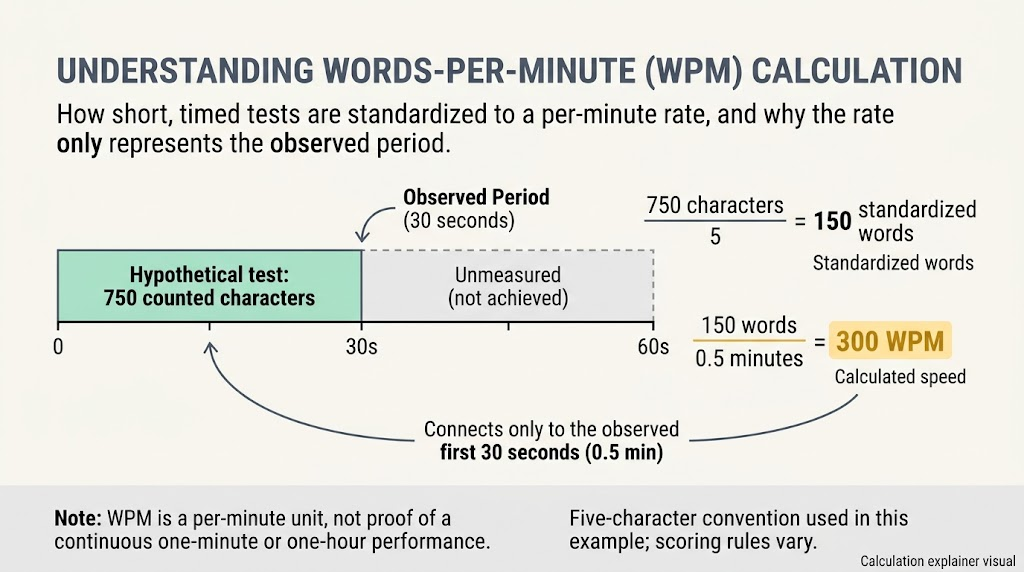
A 15-second result can still be displayed in WPM. The application converts the observed rate into a per-minute unit.
Imagine a hypothetical test with 750 counted characters completed in 30 seconds:
750 / 5 / 0.5 = 300 WPM
That calculation does not show that the person sustained the same pace for a full minute, ten minutes, or an hour. It describes the rate during those 30 seconds.
This is why duration should appear beside a fastest WPM claim. Without it, a burst and an endurance performance can look deceptively similar.
Six things to check before comparing fast typing scores
1. Test duration
Compare 60-second attempts with other 60-second attempts, or races with matching rules. A brief test offers less time for fatigue or a difficult section to affect the result.
That does not make a short test worthless. It simply answers a different question.
2. Text difficulty
A list of familiar lowercase words is different from prose containing capitals, names, numbers, punctuation, and unfamiliar spellings.
Even two passages of the same length can produce different difficulty. A score without the text mode tells you very little about everyday typing performance.
3. Error and correction rules
Does the test allow mistakes to remain? Must the typist correct them before continuing? Is the timer running during corrections? Does the published score penalize errors?
A raw number and a net or adjusted number are not interchangeable. The 2020 example above reports both an unadjusted race figure and an adjusted figure, which makes the distinction visible.
4. Input method
Separate manual typewriter, computer keyboard, touchscreen, and other input methods. Also note whether the task involves direct keyboard entry, predictive text, or another form of assistance.
A keyboard layout is part of the test conditions, not a promise that anyone who switches to that layout will reach the same score.
5. Familiarity and preparation
Was the passage new, practiced, or chosen by the participant? Were punctuation and numbers enabled? Could the attempt be restarted repeatedly until a favorable passage appeared?
These details do not automatically invalidate a result. They tell you what it demonstrates.
6. Verification and category
An organizer’s result page or record authority is stronger evidence for a specific recognized performance than an isolated screenshot.
Even a verified result needs a category. “Winner of this event” and “fastest person under every typing condition” are different claims.
Raw speed, accuracy, and useful output
Consider two fictional attempts using the same passage and duration.
Attempt A: 120 WPM, with several mistakes left in the final text.
Attempt B: 110 WPM, with the passage copied correctly.
Which is better depends on the task. For a game, use that game’s scoring rules. For an invoice, transcript, or customer email, correct final content and correction time matter.
Do not invent a universal conversion between raw and net WPM. Different tests can subtract errors, apply an accuracy adjustment, require corrections, or report separate measures.
The useful comparison is a set of results produced by the same rules, not whichever number is largest on the screen.
Build a personal benchmark you can trust
Choose a repeatable setup and write it down before the test.
Example setup: desktop keyboard, English prose, 60 seconds, capitals and punctuation included, corrections allowed with the timer running.
Then record several attempts rather than selecting only your best one.
|
Attempt |
WPM |
Accuracy shown by the tool |
Conditions |
|---|---|---|---|
|
1 |
54 |
98% |
Same mode and duration |
|
2 |
57 |
99% |
Same mode and duration |
|
3 |
55 |
99% |
Same mode and duration |
These are fictional example results. The middle WPM value is 55, which gives a more balanced snapshot of this small set than advertising only the best score of 57.
Repeat the benchmark with comparable fresh passages. If you switch from simple words to punctuation-heavy prose, start a separate comparison rather than calling the lower number a loss of skill.
The NavigationHubs Typing Sprint can serve as a general practice option. Record the settings and measures it actually provides. A personal browser score is not a certified world record.
Improve the part of typing you actually need
If you lose time at capital letters, practice short sentences with varied capitals. If your mistakes are mostly digits, work on number-entry drills. If your speed drops during longer passages, practice maintaining accuracy over a longer session rather than chasing only short bursts.
Review errors by type: missed letters, swapped letters, extra spaces, punctuation, or losing your place. A specific pattern gives you something useful to practice.
There is no need to match an elite competition score to benefit from better typing. A small improvement in accurate, comfortable everyday work is more useful than a large number achieved under unrelated settings.
Frequently asked questions
Who is the fastest typist in the world?
The answer depends on the category and date. Use a current record listing or event result for the exact format. The documented examples in this guide should not be read as a claim about the current overall leader.
Is a 300 WPM screenshot proof of a world record?
No. You would still need the test duration, text mode, scoring rules, input method, and verification. The rate alone does not establish a recognized record.
Why do two typing websites give me different WPM?
They may use different passages, timing rules, character-count methods, and error policies. Compare repeated results within one consistent setup before comparing across tools.
Does fast typing mean typing every word correctly?
Not always. Check whether the score is raw, net, or adjusted, and whether the final text contains errors. Accuracy is part of understanding the result, not an optional footnote.
The most meaningful fastest-typing claim includes its conditions. Ask how fast, for how long, on what text, under which rules, and verified by whom.