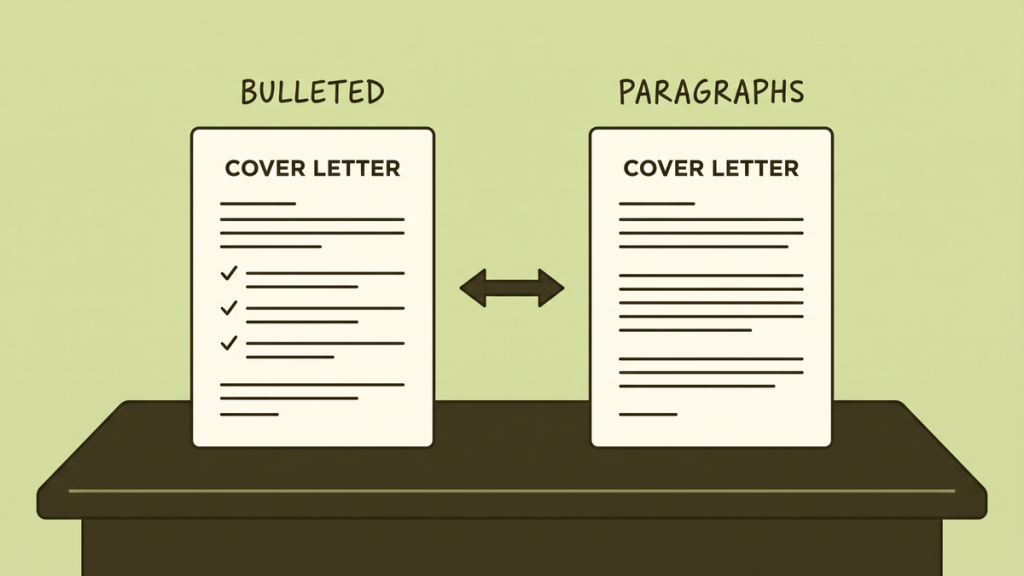
Yes, you can use bullet points in a cover letter when they make relevant evidence easier to see. The strongest use is usually a short list inside a letter, not a letter made entirely of bullets.
Keep an opening that explains why you are applying, use the list to connect your experience to the role, and finish with a natural closing. If the employer asks for a particular format, follow that instruction first.
Think of bullet points as a spotlight. They should draw attention to two or three useful examples, not turn the cover letter into a second copy of your resume.
When bullets improve the letter
Bullets are helpful when the vacancy has several clear requirements and you can offer distinct evidence for each one. A coordinator role might need scheduling, written communication, and careful record keeping. A short list can show those three connections quickly.
They can also help when a prose paragraph becomes overloaded with unrelated achievements. Instead of forcing the reader through one long sentence, give each example its own space.
However, bullets are less useful when the main value of the letter is a connected explanation. A career change, a specific motivation for the organization, or a thoughtful account of relevant experience may read better in prose.
The Yale Office of Career Strategy’s cover-letter resources provide a useful foundation for thinking about the letter as a targeted application document. The formatting choice should serve that purpose.
Compare the same evidence in two formats
Here is an original prose version for a fictional applicant:
“In my community-center role, I coordinated weekly room bookings, wrote practical updates for volunteers, and maintained attendance records. These tasks taught me to notice scheduling conflicts early, explain changes clearly, and keep information usable for other team members.”
That paragraph is already readable. It may not need bullets.
Now imagine the applicant wants to explain each skill with a different example. A bullet-led version could read:
“My experience matches three parts of the coordinator role:
- Scheduling: coordinated weekly room bookings and checked for conflicts before confirming events.
- Communication: wrote volunteer updates that separated required actions from background information.
- Record keeping: maintained attendance records so colleagues could find the latest information.”
The list is useful because it creates clear categories. It is not automatically better because it contains bullet symbols. Choose the version that makes the relevant evidence easiest to understand.
A complete bullet-led cover letter template
The following is a structure to adapt, not a set of claims to copy. Replace every bracketed item with accurate information from your own experience.
Dear [Hiring Manager Name],
I am applying for the [Role Title] position at [Organization]. Your focus on [specific responsibility or purpose from the vacancy] interests me because [brief, genuine connection]. In my work as [relevant role], I have developed experience in [two or three relevant areas].
Three examples show how I could contribute:
- [Relevant capability]: [Action you took, the context, and a truthful result or useful outcome].
- [Relevant capability]: [A different example that addresses another important requirement].
- [Relevant capability]: [Evidence that adds something not already shown in the first two bullets].
I would welcome the opportunity to bring this experience to [specific aspect of the role]. Thank you for considering my application. I look forward to discussing how my background could support your team.
Sincerely,
[Your Name]
The connecting paragraph before the list matters. It tells the reader why the examples are there. The closing matters too, because a cover letter is still a conversation with an employer rather than a standalone checklist.
A prose-first alternative for a career changer
A career changer may need to explain the connection between an old role and a new one before listing evidence. Try this structure:
Dear [Hiring Manager Name],
I am applying for [Role Title] after developing a strong interest in [relevant field or responsibility]. My background in [previous field] has given me experience in [transferable capability], which connects directly to your need for [requirement].
In [specific situation], I [action]. This required me to [relevant skill] and resulted in [truthful outcome]. The experience helped me understand that I particularly enjoy [part of the new role], and I have since strengthened that interest through [relevant course, project, or experience].
I am drawn to [Organization] because [specific, researched reason]. I would welcome a conversation about how my experience and recent preparation could support [team or objective].
Sincerely,
[Your Name]
This format may work better when the relationship between experiences needs explanation. Adding bullets would not necessarily improve it.
Write bullets that show evidence
A weak cover letter bullet says, “Excellent communication skills.” It asks the employer to accept a label without evidence.
A more useful bullet says, “Turned a long procedure into a short volunteer guide, separating setup, safety checks, and closing tasks.” It shows what the applicant actually did.
Use a simple pattern: action + context + relevant result. A result does not always need a number. It can explain what became clearer, more reliable, easier to access, or better organized, provided the claim is true.
Do not invent a percentage improvement because it looks persuasive. If you do not have a measured result, describe the contribution accurately. Honest specificity is stronger than an impressive number you cannot explain in an interview.
Keep the bullets parallel. If the first begins with an action verb, the next two should usually do the same. Avoid mixing a complete sentence, a one-word skill, and a long personal statement in one list.
How many bullets should you include?
Two or three is a useful starting point for a short cover letter. It is not a rule. The list should be long enough to show distinct evidence and short enough that the letter still feels focused.
If you have six bullets, ask whether some repeat the resume or address low-priority requirements. If one bullet runs for five lines, consider whether it contains two different ideas or needs a shorter setup.
A cover letter does not need to prove every capability you have. It should help the employer see the most relevant connection between your background and the role.
The online word counting tool can help compare a long draft with a revised version. Use the count to notice expansion, not as a substitute for judging relevance.
Formatting that survives submission
Use real bullet-list formatting in your word processor rather than typing decorative symbols and spaces. Keep the indentation modest and the text aligned consistently.
Avoid complex columns, icons, and text boxes unless the application specifically calls for a designed document. A plain, readable structure is easier to inspect in both the original file and an exported version.
If you paste the letter into an application field, check what survives. Bullets may become ordinary lines, and bold text may disappear. Make sure the meaning remains clear even without the visual styling.
Read the employer’s file-type instructions. A polished PDF is not useful if the system asks for a plain-text response or a different document format.
The final test: does the list add something?
Read your resume and cover letter side by side. If every bullet repeats a resume line word for word, the letter may not be earning its space.
Use the letter to explain relevance, motivation, or context. A resume can state what you did; the letter can connect selected evidence to this employer’s needs.
Then read the opening, the lead-in to the list, and the closing without the bullets. Do they form a coherent letter? If not, add the missing connection rather than another achievement.
Use bullet points when they help a reader see your fit. Use prose when a connected explanation is more effective. The best format is the one that makes your truthful, relevant evidence easy to follow.