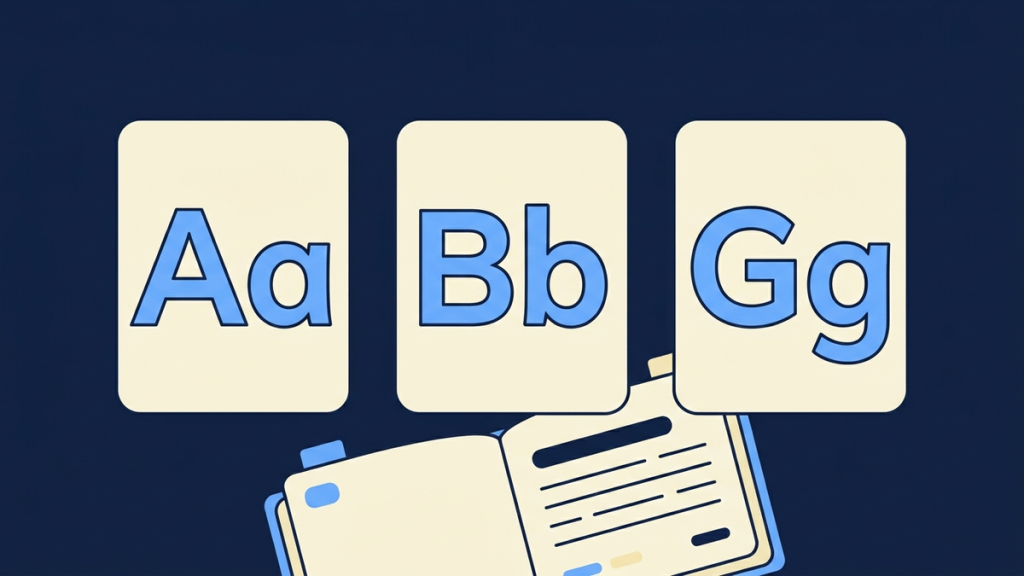
Uppercase letters are capital letters, such as A, B, and C. Lowercase letters are their noncapital forms, such as a, b, and c. They represent the same letters, but English writing uses them in different places.
For example, “Maya lives in Canada” starts with an uppercase M and gives the place name an uppercase C. Most of the other letters are lowercase.
You do not need to memorize a complicated grammar system to use them well. Start with the letter pairs, then learn a few everyday patterns.
The uppercase and lowercase alphabet
The English alphabet has 26 letters, each with an uppercase and a lowercase form.
|
Uppercase |
Lowercase |
Uppercase |
Lowercase |
|---|---|---|---|
|
A |
a |
N |
n |
|
B |
b |
O |
o |
|
C |
c |
P |
p |
|
D |
d |
Q |
q |
|
E |
e |
R |
r |
|
F |
f |
S |
s |
|
G |
g |
T |
t |
|
H |
h |
U |
u |
|
I |
i |
V |
v |
|
J |
j |
W |
w |
|
K |
k |
X |
x |
|
L |
l |
Y |
y |
|
M |
m |
Z |
z |
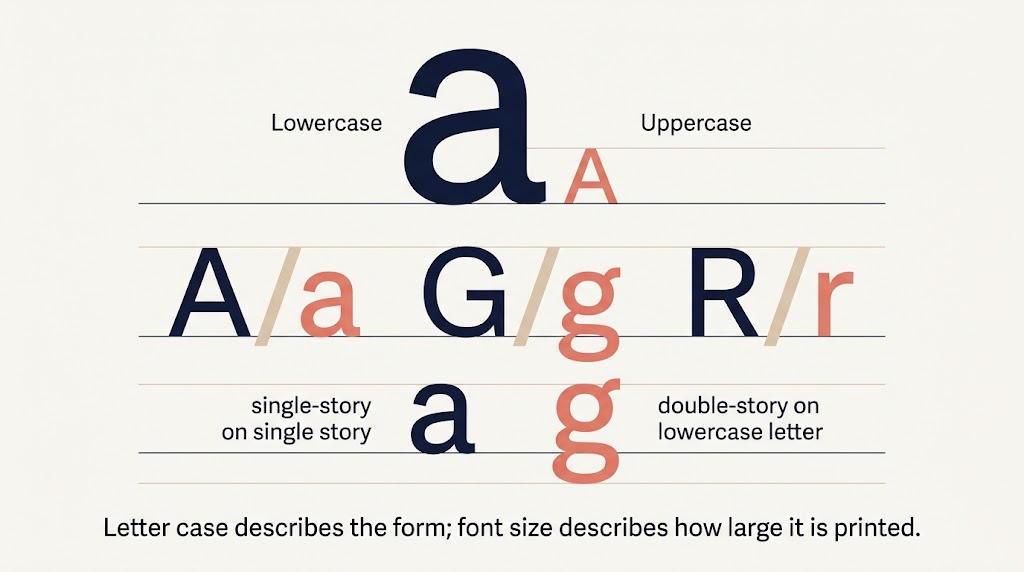
Some pairs look almost identical except for size, such as C/c and O/o. Others change shape more noticeably, such as A/a, G/g, and R/r. Fonts can also draw lowercase a and g in different ways.
That is why “small letters” is a useful informal name for lowercase, but physical size alone does not define letter case. A large printed a is still lowercase. A tiny printed A is still uppercase.
When should you use uppercase letters?
Use a capital at the beginning of a sentence, for the pronoun I, and for proper names. These are among the basic rules covered in Purdue OWL’s capitalization guidance.
Start a sentence with a capital
Write:
The meeting starts at nine. Please bring your notes.
The T and P begin separate sentences. The words inside each sentence do not all need capital letters.
Compare that with:
The Meeting Starts At Nine.
That is not the usual capitalization for an ordinary sentence. It looks more like a title or heading.
Always capitalize the pronoun I
Write “Maya and I finished the task”, not “Maya and i finished the task.” This rule applies even when I is in the middle of a sentence.
It also appears in contractions such as I’m, I’ve, and I’ll.
Capitalize specific names
A proper name identifies a particular person, place, organization, or other named thing.
|
General word |
Specific name |
|---|---|
|
a person |
Maya |
|
a country |
Canada |
|
a city |
Dhaka |
|
a language |
English |
|
a month |
October |
|
a day |
Monday |
Notice that an ordinary description does not become a proper name just because it is important. In “the manager approved the report,” manager and report usually stay lowercase.
Also, seasons generally stay lowercase in ordinary sentences: “We will visit in spring.” A season can still be capitalized when it forms part of a proper name or starts a sentence.
When should you use lowercase letters?
Most words in a normal English sentence are lowercase unless another rule calls for a capital.
For example:
“On Monday, I will send Maya the updated report.”
On begins the sentence. Monday and Maya are names. I is the pronoun. The remaining words do not need capitals.
A helpful editing question is: Why is this word capitalized? A sentence beginning or a proper name is a clear reason. “It seems important” usually is not.
Uppercase, lowercase, sentence case, and title case
These labels describe different things. Uppercase and lowercase describe letter forms. Sentence case and title case describe capitalization patterns across words.
|
Pattern |
Example |
|---|---|
|
All uppercase |
HOW TO WRITE CLEAR NOTES |
|
All lowercase |
how to write clear notes |
|
Sentence case |
How to write clear notes |
|
Title case |
How to Write Clear Notes |
In sentence case, you capitalize the opening word and any proper names. In title case, major words receive capitals, but the exact rules depend on the style guide.
Capitalize Each Word is a different instruction again. It would produce How To Write Clear Notes, including a capital T in To. That is not automatically correct APA, Chicago, or another editorial title style.
Use one intended pattern rather than randomly mixing them.
What do uppercase and lowercase mean in an online form?
A form might ask you to enter a code in uppercase. If the printed code is ab7q, the uppercase version is AB7Q. The number 7 does not change because digits do not have uppercase or lowercase forms.
The same applies to punctuation. Converting hello! to uppercase produces HELLO!, not a different exclamation mark.
For a field described as case-sensitive, copy the letters exactly as supplied. AbC7 and abc7 may be treated as different entries. Do not apply a case converter to a password, license key, or identifier unless the instructions explicitly require it.
Be especially careful with characters that look alike. Depending on the font, uppercase I, lowercase l, and the number 1 can be easy to confuse. Case conversion cannot tell you which character the original code intended.
How to change letter case without retyping
For ordinary text, paste a copy into a case converter tool and use the uppercase or lowercase option that matches your task. Keep your original until you have checked the result.
For example, converting PLEASE SEND THE FILE to lowercase gives please send the file. Turning that into a polished sentence still requires a capital P and final punctuation.
In desktop Microsoft Word, select the text and use Home > Change Case. Microsoft’s case-change instructions describe the available options, including lowercase and UPPERCASE.
A mechanical conversion does not understand every name. If you lowercase “I emailed Maya about Canada,” you will need to restore I, Maya, and Canada manually.
Try these five quick checks
Correct the capitalization without changing the meaning.
- i will call maya on monday.
- My Favorite Color Is Green.
- we studied english in october.
- The code must use uppercase letters: ab7q.
- We will travel in Summer.
Answers and explanations
- I will call Maya on Monday. Capitalize I and the two proper names.
- My favorite color is green. This is an ordinary sentence, not a title.
- We studied English in October. Capitalize the first word, language, and month.
- The code must use uppercase letters: AB7Q. Change the letters, not the digit.
- We will travel in summer. The season is not a proper name here.
Frequently asked questions
Are uppercase and capital letters the same?
Yes. In everyday writing instructions, uppercase letters and capital letters mean the same thing. Lowercase letters are often called small letters.
Is lowercase always smaller than uppercase?
No. Font size is independent of case. You can make a lowercase letter very large or an uppercase letter very small without changing its form.
Should every word in a heading begin with a capital?
Not necessarily. A heading may use sentence case or a particular title-case style. Follow the style required for the document instead of capitalizing every word by default.
For everyday writing, remember the simplest pattern: start sentences with capitals, capitalize names and I, and leave most other letters lowercase.