Two percentages can look ready to add and still give you the wrong answer. The deciding question is not whether both numbers have a percent sign. It is what each percentage is a percentage of.
You can add separate, non-overlapping shares of the same total. You cannot usually add rates from different-sized groups or combine successive price changes by simple addition. Start by identifying the total, then choose the calculation below.
Which kind of addition are you doing?
|
Your situation |
What to do |
Example |
|---|---|---|
|
Separate shares of one total |
Add the shares |
30% and 20% of the same budget make 50% |
|
Add a percentage to a number |
Multiply by 1 plus the decimal rate |
Add 15% to 200: 200 x 1.15 = 230 |
|
Apply changes one after another |
Multiply the successive factors |
20% off, then 10% off: 0.80 x 0.90 |
|
Combine results from different groups |
Add the original amounts and totals first |
Combine correct answers, not the two test percentages |
|
Compare one percentage with another |
Distinguish percentage points from relative change |
40% to 50% is 10 percentage points |
This small decision table is more useful than a single “add percentages” formula. The same numbers can mean different things in different situations.
Case 1: Both shares come from the same total
Imagine you have a $200 event budget. You reserve 30% for food and 20% for decorations. These are separate categories, both measured against the original $200.
Food costs 0.30 x $200 = $60. Decorations cost 0.20 x $200 = $40. Together they cost $100, which is 50% of the budget.
You can therefore calculate 30% + 20% = 50% directly. You get the same answer by adding the dollar amounts and dividing by the original total: $100 / $200 = 0.50.
The conditions matter: the base is the same, and you are not counting the same spending twice.
What happens when the groups overlap?
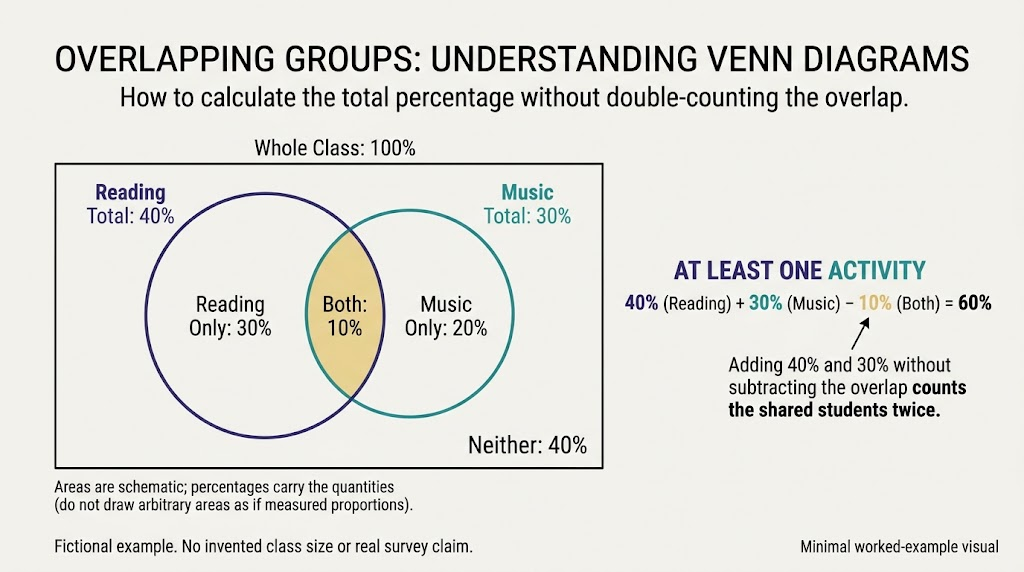
Suppose 40% of a class enjoys reading and 30% enjoys music. Adding them gives 70%, but that is not necessarily the share who enjoys at least one activity. Some students may enjoy both.
If 10% enjoys both, the share who enjoys reading or music is 40% + 30% – 10% = 60%. Without knowing the overlap, you cannot give one exact combined percentage.
A useful warning sign is a survey where people can select several answers. Its category percentages do not have to total 100%.
Case 2: You want to increase an amount
To add 15% to 200, first find 15% of 200 and then add it back:
15% of 200 = 200 x 0.15 = 30
New amount = 200 + 30 = 230
The compact formula is:
New amount = original amount x (1 + percentage / 100)
This is different from adding 15 to 200. A percentage is a rate, not a fixed quantity. Adding 15% to 400 adds 60, while adding 15% to 200 adds 30.
You can check an individual calculation with the NavigationHubs Percentage tool. Identify the original base yourself before entering the values; a calculator cannot decide what a poorly labeled percentage refers to.
Case 3: The second percentage uses a changed amount
A store offers 20% off a $100 item, followed by another 10% off the reduced price. The first discount leaves $80. The second discount is 10% of $80, or $8. You pay $72.
The total saving is $28, so the combined discount is 28%, not 30%.
Final price = 100 x (1 – 0.20) x (1 – 0.10)
= 100 x 0.80 x 0.90
= 72
Now consider two increases: 10%, followed by 20%. Starting with 100 gives 100 x 1.10 x 1.20 = 132. The combined increase is 32%, not 30%.
An increase and an equal decrease do not cancel either. A 20% rise takes 100 to 120; a subsequent 20% fall takes 120 to 96. The second change works on a different base.
For two successive percentage changes, convert each to a multiplier. Multiply the factors, subtract 1, then multiply by 100 to express the overall change as a percentage. A result below zero means an overall decrease.
Case 4: You are combining different-sized groups
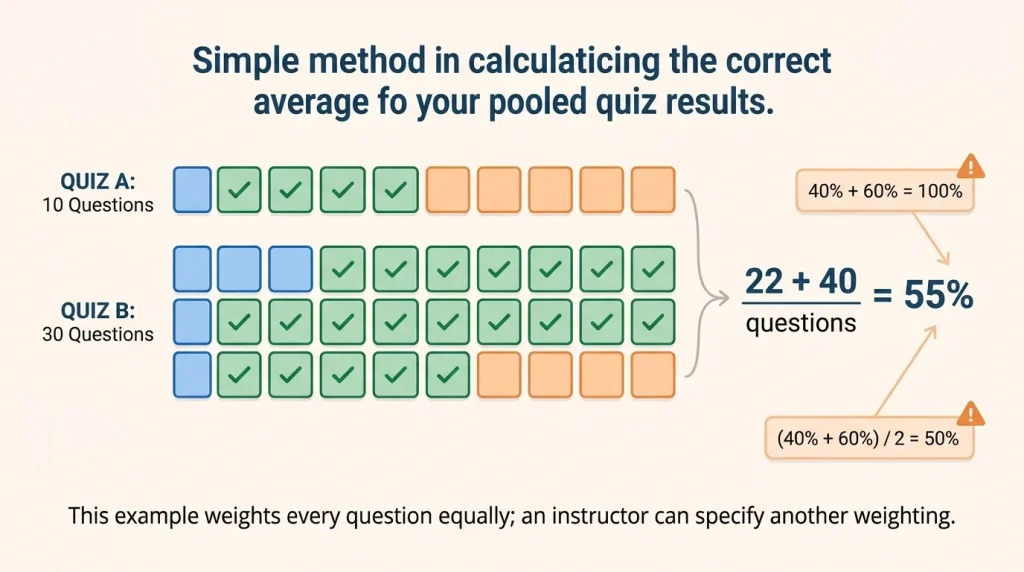
A student answers 4 of 10 questions correctly on one quiz and 18 of 30 on another. The quiz percentages are 40% and 60%.
Adding those percentages gives 100%, which is not the overall score. Taking their simple average gives 50%, which also does not describe a points-based total.
Total correct = 4 + 18 = 22
Total possible = 10 + 30 = 40
Combined percentage = 22 / 40 x 100 = 55%
The larger quiz contributes more questions. A simple average would be appropriate only if the scoring rules deliberately gave each quiz equal weight, regardless of its size.
The same principle applies when combining survey response rates or completion rates from teams of different sizes. Keep the original numerator and denominator whenever possible.
Case 5: Someone says a rate “went up by 10%”
A rate moving from 40% to 50% rises by 10 percentage points. Relative to its original level, however, the increase is 10 / 40 x 100 = 25%.
Write “10 percentage points” when describing the direct gap between the two percentages. Write “a 25% relative increase” when comparing that gap with the original 40% rate. Showing both starting and ending values makes the statement easier to check.
A final test before you add
Finish the sentence “100% means…” for each number. If the answers differ, pause. If one percentage applies after another change, use multipliers. If the categories overlap, account for the overlap. If the values come from separate groups, return to the counts.
For a quick self-check, try these three examples: 12% and 8% of the same non-overlapping budget categories make 20%; two successive 10% discounts make a 19% total discount; 8 successes out of 10 plus 9 out of 30 make 17 out of 40, or 42.5%.
The percent sign does not determine the method. The relationship between the numbers does.