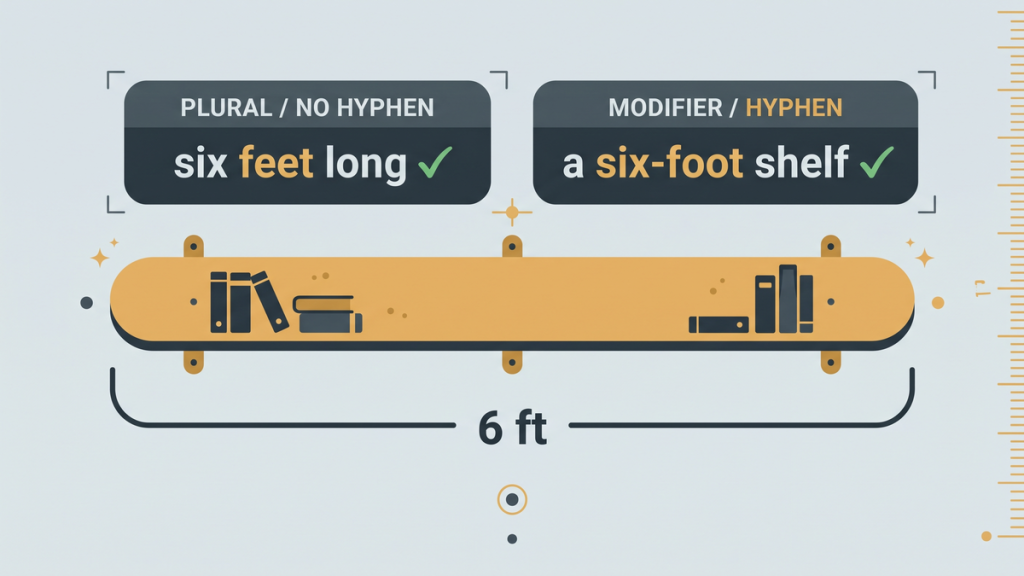
“The shelf is six feet long” is standard written English. “It is a six-foot shelf” is also standard. The number has not changed, so why has the unit changed?
In the first sentence, feet is the plural unit noun describing the shelf’s length. In the second, six-foot works as a compound adjective before the noun shelf, and the unit word stays singular.
That distinction explains most foot vs feet questions. Use foot for a singular unit, feet for an ordinary plural measurement, and foot inside a measurement modifier such as a ten-foot cable.
Let’s edit a few everyday sentences and labels rather than memorize the rule without context.
Read the sentence around the measurement
Compare these pairs:
|
Measurement after the noun |
Measurement before the noun |
|---|---|
|
The cable is ten feet long. |
We need a ten-foot cable. |
|
The shelf is four feet wide. |
It is a four-foot shelf. |
|
The ladder is eight feet tall. |
They stored an eight-foot ladder. |
|
The gap is one foot wide. |
Leave a one-foot gap. |
The measurement after the noun tells you how long, wide, or tall something is. The measurement before the noun helps describe what kind of object you mean.
VOA Learning English’s foot-or-feet explanation discusses this difference and the variation you may hear in height descriptions.
For straightforward formal writing, the table gives a dependable pattern. You do not need to treat every spoken variation as evidence that the basic rule has disappeared.
Why the compound adjective uses foot
In “a six-foot board,” the words six and foot work together as one modifier. The hyphen helps readers see that relationship before they reach the noun.
Write “a six-foot board,” not “a six-feet board.” The unit is not functioning as a separate plural noun in that position.
The same pattern appears with other measurement units: a five-inch strip, a three-meter cable, and a two-hour workshop. The grammar depends on the role of the phrase, not on the physical size of the object.
Do not add a hyphen simply because a number and unit appear together. “The board is six feet long” does not need “six-feet” in the ordinary measurement phrase.
Handle one, fractions, and decimals
For exactly one unit, write “one foot.” For ordinary measurements greater than one, use feet: “two feet,” “one and a half feet,” or “1.5 feet.”
“A half foot” is a natural phrase for half of one unit. In a numerical measurement, writers also use forms such as “0.5 feet,” depending on the style and context. Where that looks awkward, write “six inches” or “half a foot” instead of forcing a distracting construction.
Before a noun, keep the unit singular: “a 1.5-foot extension.” For readability, “an eighteen-inch extension” may be clearer in some settings.
Choose the expression that lets the reader understand the size quickly. Correct grammar should support the measurement rather than make a simple dimension harder to follow.
Write a person’s height clearly
For a complete formal sentence, “She is five feet seven inches tall” is clear. A compact label can use “Height: 5 ft 7 in.”
You may hear “five foot seven” in everyday speech. That familiar spoken form does not mean “five-feet-seven” should be copied into every formal sentence.
A phrase before a noun can become cumbersome when it includes both feet and inches. Instead of writing a very long compound modifier, move the measurement after the noun: “The athlete is six feet two inches tall.”
The aim is not to ban natural speech. It is to choose a clear written form for the audience and context, especially when measurements will be used for ordering, fitting, or record keeping.
Keep grammar separate from unit notation
The abbreviation ft can represent foot or feet. You do not add an s to make it plural. A label such as “Length: 6 ft” is therefore useful when space is limited.
In running prose, words may read more naturally: “The cable is six feet long.” In a specification table, symbols and abbreviations can be clearer if every column uses the same convention.
Prime and double-prime marks are also used for feet and inches, but a plain-text message can be easier to interpret with ft and in, particularly when quotation marks may be confused with measurement symbols.
Do not let the notation hide a missing dimension. “6 ft” says how much length, but not whether it refers to width, height, or depth. Add the dimension label when that distinction matters.
Do not confuse decimal feet with feet and inches
A measurement of 5.5 feet means five and a half feet. Since half a foot is six inches, it equals 5 ft 6 in.
It does not mean 5 ft 5 in. Five inches is 5/12 of a foot, so 5 ft 5 in is approximately 5.4167 feet.
This is an arithmetic issue rather than a grammar issue, but the two often meet in a product description. A correctly written unit word cannot rescue a number that was converted incorrectly.
The Unit Converter handles numerical length conversions. Convert mixed feet-and-inches measurements into one numerical unit first rather than assuming the tool will interpret a compound phrase.
Edit a short product description
Here is a fictional draft:
“Our six-feet shelf fits a wall that is eight foot wide. Each shelf has two foot of clear space below it.”
A clearer version is:
“Our six-foot shelf fits a wall that is eight feet wide. Each shelf has two feet of clear space below it.”
The first change fixes a compound adjective. The second and third use the ordinary plural measurement noun after the object being described.
You should still check whether the physical dimensions and clearances are correct. Editing foot versus feet improves the language, not the accuracy of the product specification.
Watch for dimensions that are not lengths
A floor area measured in square feet is not the same quantity as a length measured in feet. A room described as “120 feet” is missing important information if the writer actually means 120 square feet.
Likewise, cubic feet describes volume. Changing foot to feet will not fix a missing square or cubic qualifier.
When a sentence feels unclear, ask what quantity is being described before editing the grammar. Is it a line, an area, or a volume? Name that quantity accurately, then choose the singular or plural wording.
A quick self-check
Complete these sentences: “The rope is twelve ___ long.” “We bought a twelve-___ rope.” “The opening is one ___ wide.”
The answers are feet, foot, and foot. The first is a plural measurement, the second a compound modifier, and the third a singular unit.
For more complicated phrases, move the measurement after the noun and read the sentence aloud. “The panel is three feet wide” is often clearer than a crowded string of modifiers.
The practical rule is simple: look at the measurement’s job in the sentence. Use feet for ordinary plural lengths, foot for one unit and compound adjectives, and clear labels whenever the number will guide a real-world decision.