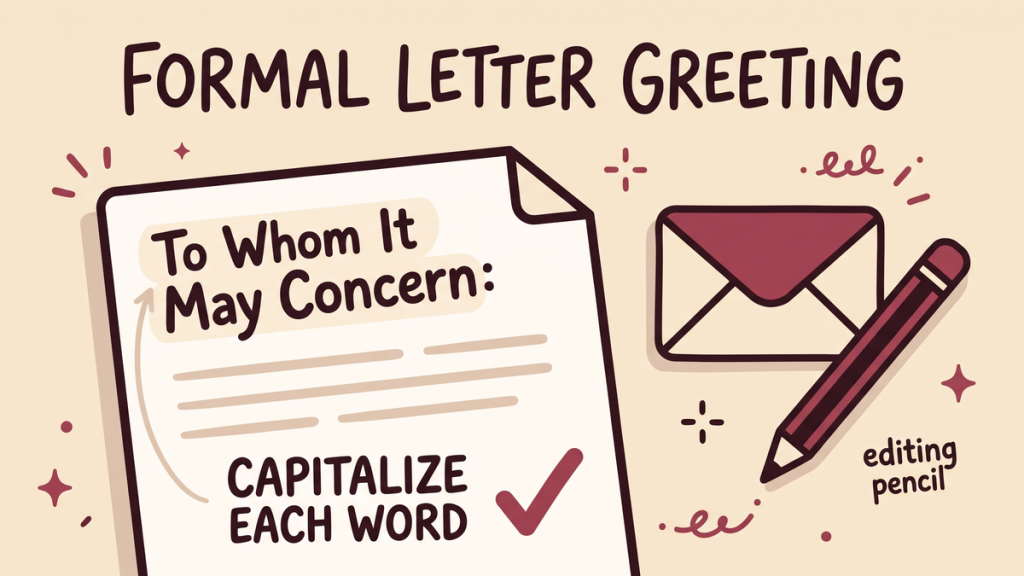
For a conventional formal-letter salutation, write To Whom It May Concern: with the first letter of each word capitalized. In US business-letter style, a colon is a common choice after the greeting.
That gives you a usable opening immediately. The more important editing question is whether this generic greeting fits the letter at all. A reference intended for several possible readers may suit it; a message to a named hiring manager usually benefits from a more specific salutation.
This guide covers the capitalization, punctuation, and placement, then shows how to choose an opening that matches the purpose without sounding stiff or careless.
The conventional form
Use this as the salutation on its own line:
To Whom It May Concern:
Begin the body on a new paragraph. For example:
To Whom It May Concern:
I am writing to provide a reference for Jordan Lee, who volunteered with our reading group during the spring program.
The capitals identify the conventional greeting. They do not mean that every similar phrase in ordinary prose should be capitalized. If you are discussing the expression within a sentence, its capitalization depends on that sentence and your editorial style.
Avoid writing the greeting in all capitals unless a particular form requires it. “TO WHOM IT MAY CONCERN” adds visual emphasis without making the letter more formal or more accurate.
Why ordinary title-case shortcuts can mislead you
A formal salutation is not simply a book title. A title-case converter may apply rules about short prepositions or pronouns that are not the convention you intended for this greeting.
The familiar salutation capitalizes To, Whom, It, May, and Concern. Treat it as a complete established opening rather than running each word through an unrelated heading rule.
The word “whom” is also part of the conventional wording. Changing it to “who” because it sounds more conversational does not preserve the same formal expression. If the greeting feels too distant for your letter, choose a different greeting instead of partially rewriting it into an awkward hybrid.
Colon, comma, or nothing?
For a formal US business letter, a colon is a conventional choice after the salutation. Purdue’s business-letter guide discusses salutation and letter-format conventions, including the value of addressing a specific person when possible.
Other organizations or regional styles may use a comma or an open-punctuation format. If you are completing an official template or following a house style, use its instructions consistently rather than treating one punctuation convention as universal law.
Do not put a full stop after the phrase as though it were an ordinary sentence. Also avoid adding both a comma and colon. A single, intentional punctuation choice is clearer than trying to make the greeting look extra formal.
Case file one: a reference for an unknown future reader
A volunteer asks for a general reference that may be shared with several organizations. You do not know who will ultimately read it. A generic salutation can fit that situation.
A simple opening might be:
To Whom It May Concern:
I supervised Jordan Lee during our spring reading program. This letter describes the responsibilities Jordan completed and the work I directly observed.
The second sentence helps establish the scope. It is better than a grand claim about the person that the writer cannot support. Use accurate details, appropriate permission, and the relevant organization’s policies when preparing a real reference.
The greeting is only the doorway. The body still needs a clear reason for writing, specific information, and an appropriate closing.
Case file two: a job application with a known team
Suppose a vacancy names the department but not an individual reviewer. “Dear Hiring Team:” or “Dear Recruitment Team:” may be more specific than To Whom It May Concern.
If a reliable contact name is supplied in the vacancy or application instructions, use it accurately. Do not guess someone’s title, gender, or preferred form of address from a first name or photograph.
An opening could be:
Dear Hiring Team:
I am applying for the operations assistant position. My recent work organizing workshop schedules has given me experience with the coordination tasks described in your advertisement.
This version connects the greeting and first paragraph to the actual purpose. It avoids a long introduction that merely announces an intention to apply without giving the reader any useful context.
Case file three: a message to a department
A letter about an invoice, delivery, or service issue often has a known destination even when you do not know the employee who will read it. Address the relevant team where the organization provides that information.
For example:
Dear Accounts Team:
I am writing about invoice 4582, dated October 12. The attached order confirmation shows the quantity we requested, and I would appreciate a review of the quantity listed on the invoice.
The greeting directs the message appropriately, while the opening identifies the record and the requested action. A generic salutation would not make the message more useful if a relevant team is already known.
Keep private account details limited to what is necessary and send them through the appropriate channel. A clear salutation does not replace careful handling of the information in the letter.
A simple choice guide
Use a named greeting when you have a reliable recipient name and know it is appropriate. Use a team or role greeting when the intended department is clear. Use To Whom It May Concern when the letter is genuinely intended for an unspecified reader or several possible readers.
If a form does not need a salutation, do not add one merely because a formal letter usually has one. Follow the actual format of the task.
The question is not whether the generic greeting is always good or always bad. It is whether it describes the audience accurately. A specific greeting should be genuinely specific, not a guessed name added for appearances.
Place the greeting within a clear letter
Keep the salutation separate from the subject line and the first paragraph. A subject line might identify the purpose, while the greeting addresses the reader. Combining them into one crowded line makes both harder to scan.
A basic structure is: date and relevant address information where needed, optional subject, salutation, opening purpose, supporting details, requested next step, and closing. The exact layout depends on the letter type and organizational convention.
For a short email, you may not need the full postal-letter structure. Keep the greeting appropriate to the channel and the relationship. Formal does not have to mean unnecessarily long.
Fix common mistakes without overediting
“To whom it may concern:” is understandable, but the conventional formal salutation uses initial capitals throughout. “To Whomever It May Concern” changes the established phrase and is usually unnecessary. “Dear To Whom It May Concern” combines two incompatible openings.
Another mistake is spending more time on the salutation than on the reader’s actual question. A perfectly capitalized greeting cannot rescue a letter that lacks a clear purpose, relevant facts, or a requested action.
The Case Converter can make mechanical case changes to pasted text, but it cannot choose the correct recipient or decide which salutation suits the situation. Check the greeting manually, especially when the rest of the letter contains names and acronyms.
The final read-through
Read the greeting and the first sentence together. Do they address the right audience and explain why the letter exists? Check the recipient’s spelling, the punctuation style, and the factual details in the opening.
Then remove repeated phrases such as “I am writing this letter to write to you regarding.” Replace them with the actual purpose. “I am requesting a copy of the schedule” is easier to understand and no less professional.
For the conventional generic opening, keep To Whom It May Concern:. Use it when the audience really is unspecified, and let the rest of the letter earn its formality through clarity, accuracy, and respect for the reader’s time.