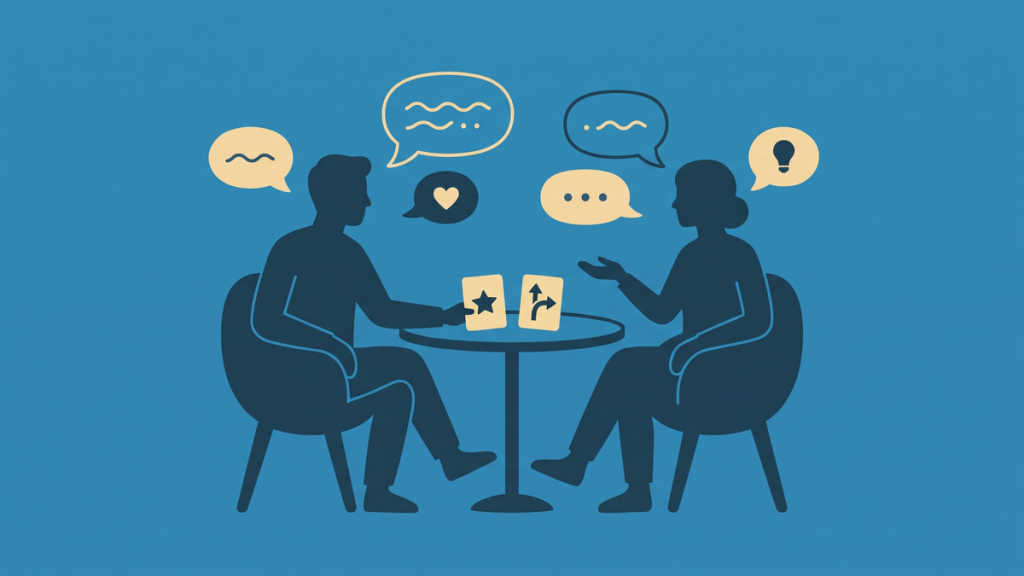
Would you rather plan a surprise afternoon together or choose every detail as a team? The answer can be playful, but the reason may reveal something useful about how each of you enjoys spending time.
These would you rather questions for couples move from easy preferences to more reflective conversations. They are not a compatibility test, a way to score a partner, or a substitute for discussing a real disagreement directly.
Pick a handful for a relaxed evening. Either person can pass, change an answer, or suggest a different question. The aim is to become curious about each other, not to turn a hypothetical choice into a promise.
Agree on the mood before choosing a question
Start with, “Do you feel like a few light questions, or would you enjoy something more thoughtful?” That gives both people a say in the kind of conversation they are having.
Keep the first round easy. A tired partner may enjoy discussing a breakfast choice more than answering a question about the next ten years. Neither preference says anything negative about the relationship.
After an answer, try “What makes that appealing?” rather than “Why would you choose that?” Tone matters. Curiosity should feel like an invitation, not an interrogation.
Round one: ordinary moments worth talking about
- Would you rather share a slow breakfast at home or go out for an early breakfast somewhere new?
- Would you rather cook a familiar meal together or try a recipe neither of you has made?
- Would you rather take an evening walk or spend that time reading beside each other?
- Would you rather choose a film in advance or browse together until something catches your attention?
- Would you rather have a quiet morning together or a quiet hour together before bed?
- Would you rather make a playlist for a short trip or choose songs as you go?
- Would you rather spend a free afternoon improving a room or leaving the house for a small adventure?
- Would you rather have dessert at home or take a walk to find a dessert shop?
- Would you rather take photographs during an outing or leave the phone away and remember it afterward?
- Would you rather receive a handwritten note or hear a thoughtful appreciation in person?
A useful follow-up is, “What would make that feel especially good to you?” The answer may be about time, attention, quiet, or shared effort rather than the activity itself.
Round two: low-pressure date ideas
- Would you rather visit a museum together or follow a self-guided walk through an unfamiliar neighborhood?
- Would you rather take a beginner cooking class or a beginner pottery class together?
- Would you rather plan a picnic with homemade food or explore a small food market?
- Would you rather watch a live performance or attend a talk about a shared interest?
- Would you rather revisit a place from early in your relationship or create a new tradition somewhere else?
- Would you rather have a planned date with every detail arranged or choose from two options that day?
- Would you rather play a cooperative game or work on a small creative project together?
- Would you rather enjoy a short local outing every week or save that time for an occasional longer outing?
- Would you rather learn a dance together at home or learn a simple song together?
- Would you rather end a date with a long conversation or with a quiet shared activity?
These are possibilities, not spending instructions. Adapt each idea to your budget, energy, access needs, and interests. A good conversation should not require either person to defend why an expensive outing is unrealistic.
Round three: discovering how you like to plan
- Would you rather make a weekend plan on Thursday or leave one part of the weekend open?
- Would you rather research several options together or have one person create a short list?
- Would you rather keep a shared calendar or have a regular conversation about the coming week?
- Would you rather finish a household task before relaxing or agree on a later time to do it?
- Would you rather divide a project into separate jobs or work side by side on each part?
- Would you rather choose a destination first or decide the kind of experience you want first?
- Would you rather keep a small collection of favorite routines or try a new routine each month?
- Would you rather receive a reminder early or agree on a single check-in near the deadline?
- Would you rather plan a trip around one main activity or leave room for several spontaneous stops?
- Would you rather decide a small shared purchase quickly or compare a few options first?
Do not use an answer to settle a live argument. “You chose planning, so you must organize everything” turns a game into a demand. A preference is useful information, not a permanent assignment.
Round four: memories and shared meaning
- Would you rather keep a small album of ordinary moments or a journal of favorite conversations?
- Would you rather recreate a memorable meal or revisit the place where you ate it?
- Would you rather hear a story from your partner’s childhood or share a story they have never heard from yours?
- Would you rather mark an anniversary with a familiar tradition or invent a new one each time?
- Would you rather save a ticket from an outing or write a few sentences about what you enjoyed?
- Would you rather make a map of places you have visited together or a list of things you have learned together?
- Would you rather hear what your partner first noticed about you or what they appreciate about you now?
- Would you rather spend an evening remembering funny mistakes or imagining a future shared project?
- Would you rather create a small time capsule together or record a short message to your future selves?
- Would you rather celebrate a personal achievement with a quiet gesture or a small gathering of people you trust?
Allow a question to remain light or become meaningful at its own pace. Nobody owes a difficult personal story because a game happened to introduce the subject.
Round five: thoughtful possibilities, without pressure
- Would you rather learn a new practical skill together or support each other in separate interests?
- Would you rather have more unplanned time together or one regular activity you can both count on?
- Would you rather ask for help early in a shared project or try a first version before asking?
- Would you rather receive encouragement through specific words or through practical help with a task?
- Would you rather discuss a small concern as it appears or agree on a calm time later that day?
- Would you rather plan a shared goal in detail or begin with one small experiment?
- Would you rather spend a free day making something useful or exploring something neither of you understands yet?
- Would you rather be surprised with a thoughtful plan or be invited to help shape it?
- Would you rather end this conversation by choosing one idea to try or simply enjoy learning the answers?
- Would you rather ask the next question yourself or let your partner invent two choices for you?
The follow-up is where the conversation opens
Imagine one person chooses planning a date together while the other prefers a surprise. It would be easy to label them “the organized one” and “the spontaneous one.” A better follow-up asks what each choice means.
One might say, “Planning together helps me know how much energy I will need.” The other might say, “A surprise feels like someone thought about what I enjoy.”
Those answers are not necessarily in conflict. A future plan could include an agreed time and activity level while leaving one pleasant detail as a surprise. The game has supplied a practical idea without declaring a winner.
Make a small set of conversation cards
Write one question on each card, with the two options clearly separated. Add an optional follow-up on the back, such as “What would make that choice enjoyable?” Keep a pass card available without explanation.
A simple digital version can use two visible choices and a separate invitation to discuss the reason. The interactive digital cards can provide a playful starting point, but any moving-button joke should remain a joke. It must not prevent a genuine refusal or be treated as agreement to a real activity.
Finish with appreciation, not a score
Choose five questions, take turns answering first, and leave space for an answer that changes after discussion. You do not need a timer unless both of you enjoy one.
At the end, share one thing you learned or appreciated. “I did not realize that planning the journey is part of the fun for you” is a more useful ending than counting how many answers matched.
Some couples will prefer silly choices; others will enjoy the reflective rounds. The right version is the one both people willingly enjoy. Use the questions to start conversations, then let the real conversation become more interesting than the original choice.