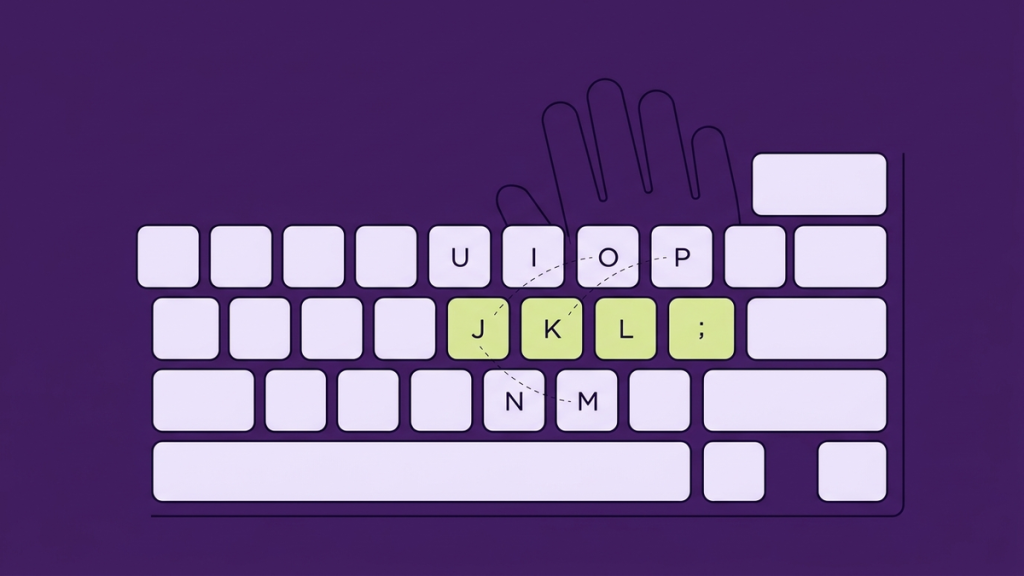
Right-hand typing practice can help you become more familiar with the right-side keys on a standard US QWERTY keyboard. Start with J, K, L, and semicolon, then add the upper and lower rows before moving to words and short phrases.
The drills below use only right-side letters and selected punctuation. They are deliberately lowercase, so you can focus on the key positions without adding Shift-key coordination.
These exercises train the right hand’s usual part of two-handed touch typing. They are not a complete method for typing the whole keyboard with one hand. That is a different skill with different adaptations.
Get familiar with the right-hand key map
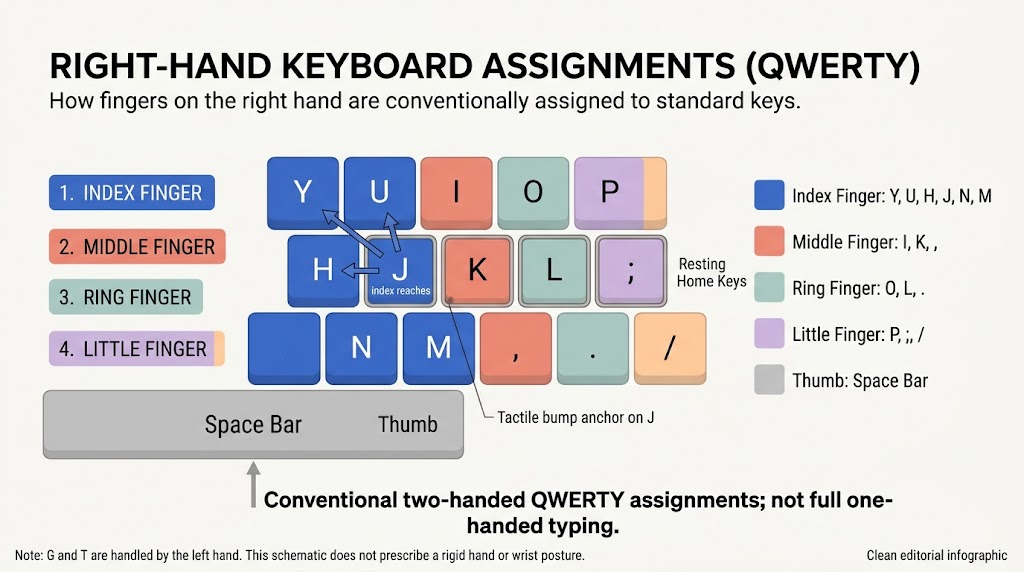
For a common US QWERTY touch-typing layout:
|
Finger |
Main letter keys |
Selected punctuation |
|---|---|---|
|
Index |
Y, U, H, J, N, M |
None in these drills |
|
Middle |
I, K |
Comma |
|
Ring |
O, L |
Period |
|
Little finger |
P |
Semicolon and slash |
|
Thumb |
Space bar |
Spaces between groups |
Your resting position is usually J, K, L, and semicolon. Many keyboards include a small raised marker on J so you can locate it without looking down.
Keyboard shapes and layouts vary. The map above is for the stated QWERTY layout, not a universal instruction for Dvorak, Colemak, phone keyboards, or specialized one-handed devices.
Keep the keyboard within comfortable reach. OSHA’s keyboard guidance emphasizes relaxed positioning and neutral wrists. Stop if the exercise causes discomfort rather than stretching harder to reach a key.
How to use the exercises
Put the source text beside an empty area in a plain-text editor. Copy one row at a time, then compare your result with the source before moving on.
Use this sequence:
- Read the row slowly.
- Type it without timing yourself.
- Check the letters, spaces, and punctuation.
- Repeat only the combinations that caused mistakes.
- Move on when the row feels controlled, not just fast.
The headings are instructions, not part of the right-hand-only drills. Type only the text inside the exercise boxes.
Level 1: the home row
Start with one key at a time, then alternate neighboring keys.
jjjj kkkk llll ;;;;
jk jk jk jk
kl kl kl kl
l; l; l; l;
jkl; jkl; ;lkj ;lkj
Keep the movement light. The goal is to know which finger belongs to each key without shifting your entire hand after every letter.
If the semicolon is awkward, practice l; slowly before adding longer combinations. Do not speed through a repeated error just to finish the line.
Level 2: index-finger reaches
The right index finger handles a larger group of letters than the other fingers in this layout.
jh hj jh hj
ju uj ju uj
jy yj jy yj
jn nj jn nj
jm mj jm mj
juh jyn jmn jhu
After each short group, find J again. Avoid hovering over the next target in a way that makes the following group harder.
Pay attention to H and Y. They are right-index keys in this conventional map even though they sit close to the keyboard’s center.
Level 3: the top row
Add U, I, O, and P, then include Y.
ui io op po oi iu
yu ui io op
yuiop poiuy
jui kilo polo yoyo
The last row starts to connect key practice with pronounceable groups and words. Treat each item as a copying task rather than guessing it from its first letter.
Level 4: the lower row
Practice N, M, comma, and period.
jn jm jn jm
ki k, ki k,
lo l. lo l.
nm mn nm mn
m, m. n, n.
Comma belongs with the middle-finger group in this map, while period belongs with the ring-finger group. Keep the difference clear rather than using the same finger for every punctuation mark without noticing.
Level 5: right-hand words
Every letter in these words comes from the right-hand letter set used in this guide.
hill milk moon noon
pool pony jump jolly
join link loop look
pink plum pump puppy
union onion nylon hymn
Words expose transitions that repeated letters do not. For example, milk moves through M, I, L, and K. If you consistently mistype that word, slow down that sequence rather than repeating the whole page.
Some common-looking practice endings are not right-hand-only. For example, ing contains G and tion contains T, both normally assigned to the left hand. They are not included in these right-hand drills.
Level 6: punctuation without capitals
milk, oil, onion.
pink; plum; nylon.
moon/noon
jill, look in my pool.
only milk, no oil.
This level adds commas, semicolons, periods, and a slash. Match the spaces exactly. A missing space is still a copying mistake even when every letter is correct.
These are intentionally lowercase exercises, not examples of finished sentence capitalization.
Level 7: short right-hand phrases
my pink pony
my jolly puppy
noon in july
jim, join my union.
jill, look in my pool.
my pony, my puppy.
The vocabulary is limited because the exercise excludes left-hand letters. That is useful for isolating a skill, but it does not replace normal writing practice.
Once these phrases feel controlled, return to ordinary two-handed text so the trained movements fit back into your usual typing.
Level 8: return to normal two-handed typing
The following passage is not right-hand-only. It is a transition exercise for using both hands again:
I will review the notes before lunch. The final copy needs clear
headings, careful punctuation, and a few useful examples. After I
finish, I will check the details and save the updated document.
Use your normal two-handed method. Notice whether the right-side letters feel easier, but do not expect the restricted-word drill and this full passage to produce the same speed.
For additional general passage practice, check out our typing speed test. It is not a specialized right-hand mode, and these exercises can be practiced separately without importing them into the tool.
Track the errors that repeat
Use a simple log rather than judging the whole session by one WPM figure.
|
Session |
Exercise |
Mistake noticed |
Next practice choice |
|---|---|---|---|
|
Example 1 |
Index reaches |
H typed instead of J |
Repeat jh and hj slowly |
|
Example 2 |
Word groups |
Letters swapped in milk |
Practice milk in short sets |
|
Example 3 |
Punctuation |
Period used for comma |
Repeat m, and m. separately |
|
Your session |
For a word drill, you can count exact matches. If 18 of 20 words match the source before correction, that is 90% exact-word accuracy for that attempt. It is not the same measure as a tool’s character-level accuracy.
Keep a note of corrections and time. A slower clean attempt may tell you more about control than a faster attempt with the same repeated mistake.
A short routine you can repeat
Try two minutes of home-row and index-finger groups, two minutes of words, one minute of punctuation, and one minute of normal two-handed text.
Repeat a difficult level instead of advancing automatically. A learner who still mixes up J and H does not need a longer drill; they need a manageable way to practice that specific movement.
There is no promised improvement timetable. Your starting point, keyboard, practice conditions, and comfort all affect the experience.
Right-hand practice versus typing with one hand
These two goals are easy to confuse.
Right-hand practice for touch typing strengthens familiarity with the keys normally assigned to that hand. Your left hand still handles its own letters when you type normal text.
Full one-handed typing means entering all letters and commands using one hand. That may require a different technique, keyboard configuration, or accessibility setup. Reaching across the entire keyboard is not the next level of this drill sequence.
If an injury or mobility limitation affects your typing, choose an approach suited to your needs rather than treating a standard touch-typing chart as medical or rehabilitation advice.
Frequently asked questions
Which letters are typed with the right hand?
In the conventional US QWERTY map used here, the letters are Y, U, I, O, P, H, J, K, L, N, and M. Other layouts use different assignments.
Why are the exercises lowercase?
They isolate right-side key movements. Normal touch typing often uses the opposite hand’s Shift key for a capital, which would add another skill to the exercise.
Can I do these drills without a special website?
Yes. Keep the source visible and copy it into a plain-text editor. Compare the result yourself and record the errors you want to work on.
Should I practice only my right hand?
Not for ordinary two-handed typing. Use focused drills for a specific weakness, then return to full text so both hands work together.
Build familiarity in small steps: home row, reaches, words, punctuation, and normal text. Accuracy and comfortable control should come before speed.